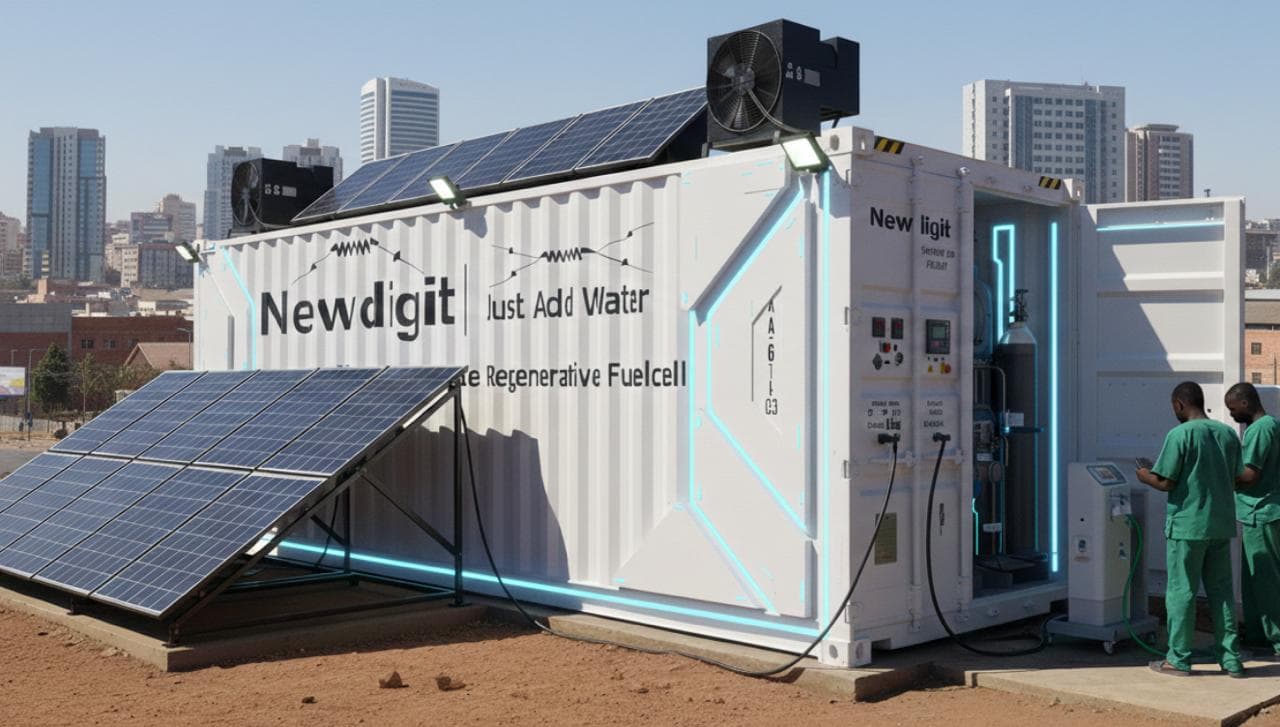
Just Add Water by Newdigit: Clean Power, Oxygen, and Water for Off-Grid Healthcare
Newdigit's Just Add Water is more than a memorable product name. It is a signal of intent: a compact clean-energy system designed to deliver electricity, medical-grade oxygen, and deionised water for healthcare settings that cannot afford fragile infrastructure.
In regions where power cuts, diesel dependence, and oxygen shortages can directly affect patient care, the idea is both practical and ambitious. The real value of the system is not the slogan, but the engineering behind it.
Why the problem is urgent
Healthcare facilities across many parts of Africa still operate under severe energy constraints. When the grid is unreliable, hospitals fall back on diesel generators, which are expensive, noisy, polluting, and difficult to maintain.
Oxygen shortages make the situation worse. In emergency care, maternal health, and critical care, oxygen is not optional. It is essential. A facility that cannot reliably power its equipment or secure oxygen supply is facing a real clinical risk.
What Just Add Water is designed to do
According to Newdigit's positioning, Just Add Water is a closed-loop energy and resource system for hospitals and related facilities. The system is designed to turn greywater into useful outputs, including electricity, medical-grade oxygen, and deionised water.
That makes it more than a power solution. It is a multi-utility platform for resilience, especially in off-grid or weak-grid environments where infrastructure is often uncertain.
How the technology works
At the center of the system is a combination of solar PV and regenerative PEM fuel-cell technology. Solar handles energy generation, while the fuel-cell architecture supports continuity and controlled output. Newdigit also describes oxygen compression and purification as part of the same system, which is a major differentiator in healthcare resilience planning.
The inclusion of a water component makes the architecture even more interesting. Deionised water output suggests the system is intended to support medical operations and broader local needs, not merely provide basic electricity. That gives it a wider utility profile than a conventional backup power setup.
Why this is newsworthy
A lot of clean-tech products sound impressive on paper. What makes Just Add Water newsworthy is the combination of ambition, specificity, and real-world relevance. It is tied directly to a critical sector, a difficult geography, and a pressing operational problem.
The broader policy and investment angle is also strong. Governments, donors, and impact investors are increasingly looking for infrastructure solutions that combine resilience, decarbonisation, and local relevance.
The healthcare impact
Hospitals need three things that are often treated as separate: electricity, oxygen, and clean water. In under-resourced settings, those are not background utilities. They are frontline enablers of care.
- Continuous electricity supports lighting, refrigeration, monitoring equipment, and communications.
- Medical-grade oxygen supports respiratory care, surgical services, and emergency response.
- Clean or deionised water supports hygiene, sterilisation, and operational safety.
When those inputs fail, care quality drops fast. When they are dependable, hospitals can do more with less stress and fewer interruptions. That is why the system's integrated design matters so much.
A platform built for scale
Another reason the story matters is that it appears to be built with scale in mind. Newdigit says its broader work includes PEM fuel cells, electrolyzers, and related materials and components for applications in healthcare, agriculture, and supply-chain optimisation across Africa.
If the architecture proves reliable, it could be adapted for different environments and institution sizes, from smaller clinics to larger hospitals. That is the kind of engineering logic that investors and operators alike understand.
The business case behind the mission
The business case for Just Add Water is rooted in total cost of ownership. Diesel generators may appear cheaper at the point of purchase, but their lifecycle costs are high. Fuel, maintenance, logistics, breakdowns, and emissions all add up.
Hospitals also pay an invisible cost every time a generator fails at the wrong moment. A more integrated system can improve predictability, which matters in healthcare because budgets, staffing, and patient outcomes all suffer when support systems are unstable.
Why the brand name works
From a branding perspective, “Just Add Water” is strong because it is instantly understandable. It suggests simplicity without requiring a technical background, which makes it easy to remember and easy to share.
But for the name to carry weight, the content around it has to be credible, detailed, and evidence-based. That is why the best way to write about the product is to frame it as a response to a measurable problem, not as a slogan looking for attention.
FAQ
What is Just Add Water by Newdigit?
It is a clean-energy and resource system designed for healthcare settings, combining electricity generation, medical-grade oxygen, and water purification in one platform.
Why is it important for hospitals?
Hospitals depend on stable electricity, oxygen, and clean water. Just Add Water is designed to reduce dependence on fragile infrastructure and diesel generators.
Is this only a power solution?
No. Newdigit positions it as a multi-utility system that supports healthcare operations through energy, oxygen, and water outputs.
Who is it for?
The primary use case is off-grid and weak-grid healthcare facilities, but the broader platform could support other environments that need resilient infrastructure.
Conclusion
Newdigit's Just Add Water is ambitious, but the ambition is grounded in a real need: making essential care more reliable where reliability has too often been missing. As healthcare systems across Africa face rising pressure, solutions that combine clean energy, oxygen generation, and water purification could become increasingly important.
The significance of the project is not just that it is innovative. It is that it is trying to solve a structural problem with a practical system that has the potential to scale. That is what makes it worth watching.